Medically reviewed by Dt. Tunç Berge, MSc: Esthetic Dentistry & Implantology. Last reviewed March 2026
Corticobasal Implants for Full Mouth Restoration: How They Work and Who They Suit
- TEMOS-accredited clinics
- JCI-accredited hospitals
- Board-certified surgeons and a licensed clinical team
- 3,000+ international patients treated
A NexWell guide on corticobasal implants for full-mouth restoration, explaining how this approach differs from conventional implants, when bone grafting can be avoided and what patients should verify before considering this route.
Written quote from a NexWell coordinator, usually within 24 hours.
Quick answer
Corticobasal implants anchor in denser cortical and basal jaw bone rather than the crestal bone used by conventional implants, which can allow full-arch treatment for some patients with significant bone loss without extensive grafting. The approach needs specific clinical training, so ask any Turkish clinic to name their exact protocol and case experience before committing.
What Corticobasal Implants Are and How They Differ From Conventional Implants
Corticobasal implants are a category of dental implant designed to anchor in the cortical and basal bone layers of the jaw rather than in the upper crestal bone where conventional implants are typically placed.
Because basal bone is denser and less affected by the resorption that follows tooth loss, this anchoring strategy can allow implant placement in patients who have experienced significant bone volume loss and who might otherwise require extensive bone grafting before conventional implants could be used.
The most recognised protocols in this category include basal BOI implants, Bicon-style wide-diameter implants and corticobasal screw implants. Different clinics and clinicians use these terms somewhat differently, so patients should ask their clinic to specify exactly which implant design and protocol is being proposed rather than relying on the category name alone.
The claimed clinical advantage of corticobasal approaches is that they enable immediate or early loading in patients with reduced bone volume, potentially compressing the treatment timeline compared to a conventional implant-plus-graft pathway. The tradeoff is that the technique requires specific clinical training and is not universally available across all implant dentistry practices.
The most recognised protocols in this category include basal BOI implants, Bicon-style wide-diameter implants and corticobasal screw implants.
When Corticobasal Implants Are Considered and Who They May Benefit
Corticobasal implant protocols are most commonly discussed for patients who have experienced significant bone resorption after long-term tooth loss, patients who have been told they are poor candidates for conventional implants without bone grafting, and those who want to avoid the additional cost, time and recovery associated with major bone grafting procedures such as sinus lifts.
They may also be considered for patients who have previously had failed conventional implants and whose residual bone volume is now insufficient for a standard replacement approach.
Not every patient with bone loss is a corticobasal candidate. The suitability assessment requires a full CBCT scan and clinical evaluation by a clinician with specific experience in basal protocols. Patients should not self-diagnose suitability based on online research alone.
The Bone Graft Question: When Corticobasal Genuinely Avoids It and When It Does Not
One of the most marketed claims surrounding corticobasal and similar protocols is that they allow treatment without any bone grafting. This is sometimes accurate and sometimes an oversimplification.
When the lower jaw retains adequate cortical and basal bone density, corticobasal-anchored implants can indeed be placed without grafting. In these cases, the timeline advantage compared to conventional implant-plus-graft planning can be significant.
However, not all cases promoted as no-graft corticobasal situations are equivalent. Some cases still require soft tissue management, residual ridge preparation or adjunctive procedures that add time and cost.
Patients should ask the clinic to be specific about what is and is not included in the proposed no-graft approach and whether any case-specific complications might reintroduce grafting requirements once imaging is fully reviewed.
Treatment Plan
Ready for a written Corticobasal Implants for Full Mouth Restoration: How They Work and Who They Suit quote?
A NexWell coordinator reviews your case and replies with a personalised treatment plan and indicative pricing — usually within 24 hours.
Using Corticobasal Implants for Full-Mouth Restoration: What the Process Involves
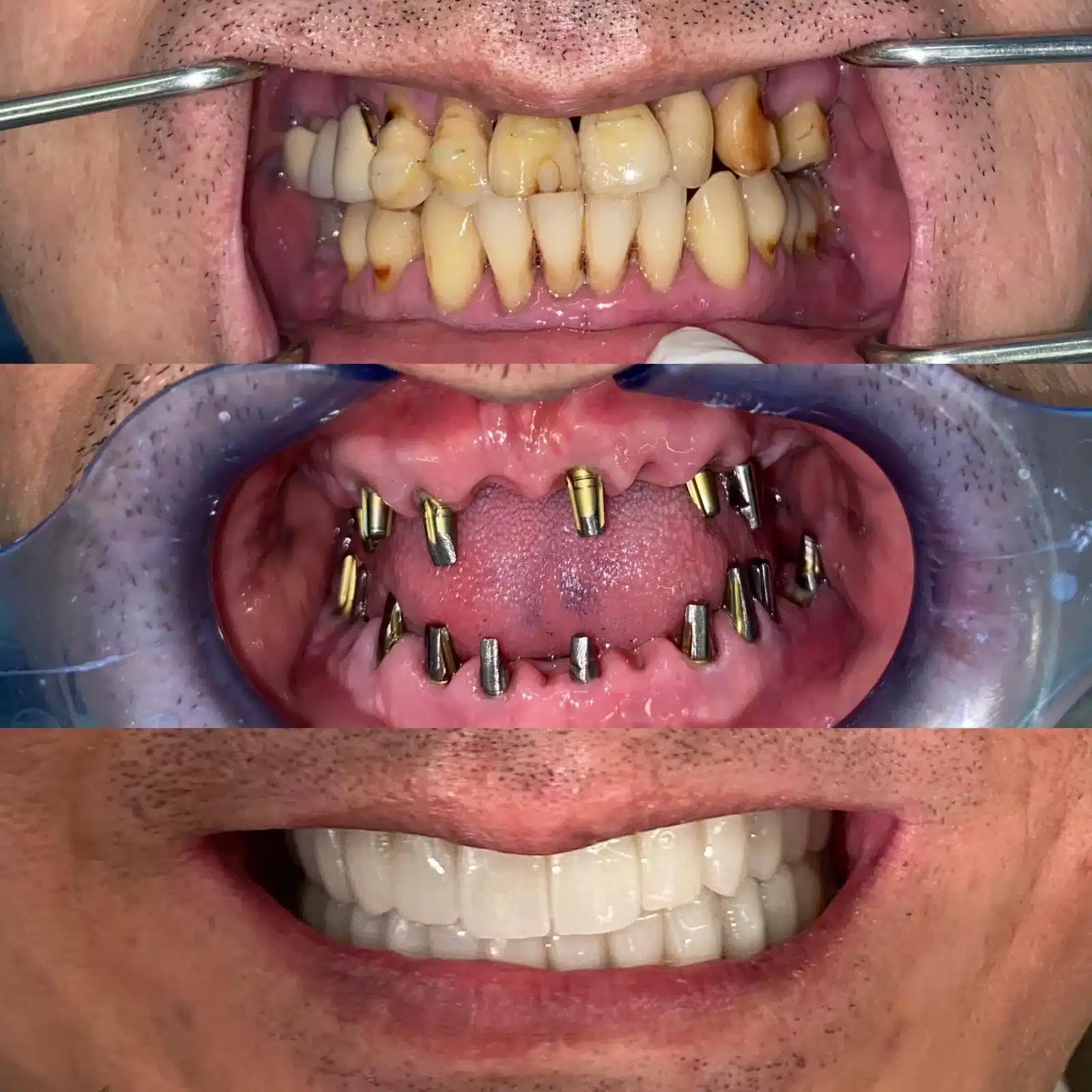
In a full-mouth restoration context, corticobasal implants are typically used to support a complete arch prosthesis in patients who cannot follow standard All-on-4 or All-on-6 pathways due to bone volume limitations. The implants are placed within a single surgical session with the goal of loading a fixed provisional arch on the same day or within a short interval.
The prosthetic restoration sits on the implant framework and is typically acrylic or a composite hybrid in the provisional phase, with a more durable definitive prosthesis planned after integration assessment.
Full-mouth corticobasal cases have a more complex logistical profile than conventional implant cases. They require experienced planning, a clinician with demonstrated proficiency in the specific protocol and a lab capable of producing compatible prosthetics.
Patients should seek evidence of a track record in full-mouth corticobasal rehabilitation before committing to this route rather than relying on general implant experience references.
What the Evidence Base Supports and Where Caution Is Warranted
Corticobasal and basal implant protocols have a growing clinical literature, particularly for highly resorbed cases where conventional options have limited precedent. However, the evidence base is less extensive than for conventional implant systems, and long-term follow-up data beyond ten years is less abundant.
In Turkey, corticobasal protocols are offered by a subset of clinics that have invested in clinician training and the specific implant inventory required. The standard of training and patient selection discipline varies between providers, which means the outcome quality for patients choosing this route depends more heavily on the individual clinician's case experience than in conventional implant dentistry.
Corticobasal treatment is therefore best understood as a legitimate but less extensively documented option, neither one to dismiss outright, nor one to choose by default over a conventional plan.
For qualifying patients with significant bone loss, a well-executed corticobasal case can offer a direct and cost-effective route to fixed teeth; for patients who are also candidates for conventional implants with grafting, the more established evidence base of the conventional route deserves equal weight in the decision.
Either way, the key is verifying that the clinic's track record matches the case complexity being proposed.
How NexWell Reviews a Corticobasal Proposal Before Making a Recommendation
When NexWell evaluates a corticobasal implant proposal, we look specifically at whether the case genuinely benefits from this approach or whether it is being proposed to patients who could follow a more conventional pathway at lower clinical risk.
We review whether the CBCT analysis has been comprehensive, whether the clinician can document prior cases of similar complexity, whether the prosthetic design is appropriate for the bone anchor points being used and whether post-travel support is realistic given the complexity of full-mouth implant rehabilitation.
For patients who are strong candidates and whose bone anatomy genuinely warrants it, corticobasal implants in Turkey can represent an excellent value pathway to full-arch restoration. For patients who have been steered toward it primarily as a marketing differentiator rather than a clinical solution, the risk profile is less favourable than a well-planned conventional full-arch approach.
What a Full-Mouth Corticobasal Treatment Visit Looks Like in Turkey
A full-mouth corticobasal restoration in Turkey typically requires more pre-surgical planning than a standard implant case. The first appointment focuses on comprehensive imaging, case planning review with the treating clinician, and sometimes a second-opinion consultation if the case is complex.
Surgery is usually performed in a single session under sedation or general anaesthesia, with provisional teeth loaded on the same day or within forty-eight to seventy-two hours in most protocols. Post-surgical management focuses on swelling, occlusal stability of the provisional arch and early bone-implant interface assessment.
For international patients, the initial surgical visit is typically seven to twelve days to allow for surgery, rest, adjustment and departure clearance. A follow-up visit is usually required at three to six months for definitive prosthetic planning and a functional assessment of integration.
Patients should confirm in advance that the clinic has a dedicated protocol for international patients managing corticobasal follow-up from abroad, including remote review and a defined standard for when return travel is required versus when concerns can be managed locally.
Questions to Ask Before Choosing Corticobasal Implants in Turkey
Corticobasal treatment is a specialised route, not a default one. Get written answers on:
- What specific implant design and protocol is being proposed: BOI, screw-type corticobasal, Bicon or another system?
- How many corticobasal full-mouth cases has the treating clinician personally completed?
- Can the clinic provide case documentation or references from full-mouth corticobasal patients at twelve months or beyond?
- Is conventional implant-plus-graft still an option for this case and what are the tradeoffs?
- What does immediate loading mean in this plan: same-day fixed teeth or a phased loading approach?
- What is the prosthetic material and design at provisional and definitive stages?
- What is the protocol if an implant in the corticobasal anchor fails to integrate?
- How does the clinic manage post-travel oversight for this complexity level?
Corticobasal implant treatment is appropriate for some patients but not all. A clinic willing to name a specific case count and offer a conventional alternative is showing the difference between patient-appropriate casework and technique-first marketing.
How NexWell Reviews Corticobasal Implant Proposals Before Recommending a Clinic
NexWell applies specific scrutiny to corticobasal implant proposals because this technique is sometimes marketed aggressively to patients who may also be suitable for conventional implants with grafting, and the decision between them has significant long-term implications.
The review begins by asking whether the treating clinician has provided a clinical rationale for corticobasal anchoring that is grounded in the patient's imaging findings rather than in practice philosophy or commercial preference.
We check whether the clinic has offered the patient a parallel conventional treatment plan for comparison, including its associated timeline, cost and limitations, so that the choice is genuinely informed. Patients who are presented with only one pathway and told that conventional options are not possible without a proper explanation should proceed cautiously.
For the specific surgical team, we assess documented case volume in corticobasal full-mouth restoration. This is a technically demanding protocol where the learning curve is steep and outcomes at early career stages are more variable than in established conventional implantology.
We also review the prosthetic plan, specifically checking whether the provisional and definitive bridge design is appropriate for basal anchorage loading characteristics, which differ from conventional implant loading in ways that must be reflected in the prosthetic engineering.
For patients who proceed with a well-reviewed corticobasal plan, Turkey offers the procedure at a fraction of the cost charged in Western Europe, making the case for careful evaluation rather than avoidance.
Vetted partner network
NexWell coordinates with TEMOS-accredited clinics or Ministry of Health–licensed facilities in Turkey.
Board-certified review
Content reviewed by Dt. Tunç Berge — Turkish Dental Association (TDB).
5.0★ from real patients (5 reviews)
“I was told by two dentists at home that I didn't have enough bone. They did the graft and implants in one trip. Six months later I came back for the final crowns. Incredible team.” — Mark T., Dublin, Ireland
No obligation
Get your Corticobasal Implants for Full Mouth Restoration: How They Work and Who They Suit plan
Send your case and a coordinator returns a written plan and an indicative quote — usually within a day.
Questions Patients Ask Before They Commit
Related reading
dental
Dental Implants in Turkey
Replace a single tooth or your entire smile with premium dental implants in Istanbul. Same brands as London specialists, a fraction of the cost. 5-day treatment packages. TEMOS-accredited dental clinics.
dental
All-on-4 Dental Implants in Turkey
Complete full-arch restoration anchored by just four strategically placed implants: often delivered as same-day teeth. Save up to 90% compared to UK and US prices, without compromising on quality or safety.
dental
All-on-6 Dental Implants in Turkey
Six strategically placed implants provide superior arch stability compared to All-on-4: ideal for patients with lower bone density or heavier bite forces. Same-day teeth, TEMOS-accredited clinics.
dental-treatments
Full Mouth Dental Implants Turkey: Planning, Cost Logic and Case Selection
A buyer-focused guide to full mouth dental implants in Turkey, including who qualifies, what changes the budget, and how to compare All-on-4, All-on-6, and staged rehabilitation.
Plan the next step clearly
Use this page as a decision-support guide, then move into quote review, treatment comparison, and travel planning with coordinator support.
Decision Context
Patients compare this treatment inside the trip around it
Treatment pages perform better when they acknowledge arrival flow, destination trust, and the recovery rhythm patients are trying to visualise before booking.

The provider decision starts with arrival confidence
Patients compare treatment pages while also asking how first-day logistics, transfers, and scheduling will actually work.

The destination still influences medical trust
A treatment page is stronger when it recognises that the city itself remains part of the decision frame for international patients.

Recovery pacing changes how people evaluate options
Different procedures feel more or less realistic depending on how patients picture the slower hours between appointments.