Basal implants vs conventional implants: what the evidence shows, and for whom
Basal implants anchor in dense cortical bone for severe bone loss. See what studies report, where the evidence is thin, and who should stay conventional.
Quick answer
For suitable patients, basal implants can mean no bone graft and a fixed bridge within days, because they anchor in the dense cortical bone of the jaw instead of the softer bone near the ridge. Most studies are observational and long-term randomised data are limited, so suitability is decided by a CBCT scan and an examination.
Patients who have been told they have too little bone often meet this implant type through a clinic's marketing. This guide sets the marketing aside and reads the papers. It covers what the design is, what the published results report, how to read that evidence, who the approach suits and which situations call for another plan. It is general information, not a diagnosis.
Only a CBCT scan and an examination can tell you what suits your jaw.
What basal implants are, and what they are not
Conventional implants are designed to fuse with the softer, spongy bone near the top of the ridge, which is also the bone that shrinks first after tooth loss. Basal implants take a different route. They are longer screws, usually one-piece, that are driven into the dense cortical layers of the jaw, for example the pterygoid region behind the upper teeth (Lazarov 2019).
The terms corticobasal and Strategic Implant are used for the same family of devices, and the studies below include models such as KOS from Ihde Dental.
Two details matter for patients. The neck is polished and thin, and in some designs it can be bent during surgery to line up several implants. Compression screws, a related type, are placed in undersized holes to condense spongy bone.
In a 20-year follow-up report on a single patient, the system's developer states that compression screws need compressible bone and are not indicated for very dense (D1) or non-mineralised (D4) bone (Ihde and Ihde 2018).
So "basal implant" is not one product. It covers several designs with different bone requirements, and the older lateral basal plates are a different device again. The label tells you the concept, not the exact implant your clinic would use.
What the published studies report
Most of the literature comes from a small group of authors and from clinics that use the system daily. The table lists the main papers in plain terms.
| Study | Design and size | Follow-up | Reported result |
|---|---|---|---|
| Jani et al. 2022, Healthcare | Multicentre, retrospective, 151 patients, 1,057 one-piece compression implants | Mean 22.3 months, maximum 82 | 1,041 of 1,057 in full function (98.5%) |
| Patel et al. 2025, Ann Maxillofac Surg | Retrospective, 5,108 implants, patient count not stated | Reported in the paper; not every patient attended on schedule | 154 failures (80 upper, 74 lower), about 97% survival |
| Lazarov 2019, Ann Maxillofac Surg | Prospective, one provider, 87 patients, 1,169 implants reported in detail | At least 48 months, up to 57 | 4-year cumulative survival 97.5% (cortical screws) and 98.4% (compression screws) |
| Patel et al. 2021, Ann Maxillofac Surg | Prospective, 10 patients, 157 implants | 1 year | 4 implants failed (97.5%) |
All four are case series or cohorts. None compares basal implants with conventional implants, so the table cannot show which approach is better, only what happened to the patients who were treated. Percentages are reported by the authors and were not re-calculated here.
Basal vs conventional implants side by side
The table puts the two approaches next to each other using only the papers cited on this page. Where a cell says the studies did not cover something, that is a gap in the evidence, not a hidden answer.
| Question | Conventional implants | Basal (corticobasal) implants |
|---|---|---|
| Where it anchors | Softer, spongy bone near the top of the ridge | Dense cortical layers of the jaw, for example the pterygoid region (Lazarov 2019) |
| Bone graft | May be needed first when bone has shrunk | Designed to avoid augmentation, but only your scan shows whether that works |
| Angle correction | Usually two-piece, so an angled abutment can be chosen after healing | Usually one-piece; the neck can be bent during surgery in some designs |
| Time to a fixed bridge | Immediate full-arch upper bridges show no clear difference from delayed loading, with limited trial evidence (Abdunabi 2019) | About three days in the protocols studied (Patel 2025) |
| Bridge and removal | Ask how the bridge is fixed; not compared in the studies here | Usually cemented; fractures and slow, uncomfortable removal were recorded (Patel 2025) |
| Peri-implantitis | 19.5% of patients and 12.5% of implants in a 2022 meta-analysis of 57 studies with at least five years of function (Diaz 2022) | None reported in the Lazarov and Patel 2025 series, with short follow-up; not directly comparable |
| Single front tooth | Not compared in the studies cited here | May be less aesthetic, according to a 2026 review abstract (Joshi 2026) |
| Evidence base | Wider literature, including pooled analyses such as the 57-study Diaz review | Case series and cohorts; none of the studies cited here compares them with conventional implants |
The peri-implantitis row mixes different populations, follow-up lengths and definitions, so read it as context rather than a score. Neither column shows a proven winner.
Who a basal plan suits
A basal plan is most often considered for adults who have lost a lot of jawbone after years without teeth or with a loose denture, who have been told they need a graft before any implant, or whose earlier implants or grafts did not work. It also suits people who want fixed teeth within days instead of months, who keep their gums and teeth clean and whose general health is stable.
Patel 2025 and Patel 2021 describe this kind of patient, and the cohorts also included people with diabetes and smokers.
The benefit, for a suitable patient, is a shorter route: no graft stage, implants placed in one session and a fixed bridge fitted within about three days in the protocols studied.
How to read the evidence
Survival figures near 98% are encouraging, and they come with context. Most of the studies are observational: the patients were followed after treatment rather than randomly assigned to different implants, and several come from teams that use the system every day. Follow-up is mostly five years or less, and none of the studies cited here is a randomised comparison with conventional implants.
Two patterns matter for patients. The authors link many losses to overload from heavy or one-sided chewing, which is why the bite plan and regular check-ups are part of the treatment rather than an extra. And the necks of these implants are sometimes bent during surgery to line up the bridge.
In the largest prospective series, survival was not significantly different for bent and unbent implants (Lazarov 2019).
In a 2019 series by Pałka and Lazarov, 376 of 1,019 implants (36.9%) had bent necks (Pałka and Lazarov 2019). It appears to describe the same 87 patients as the Lazarov cohort, and the 1,019 implants are part of that cohort's 1,169, so the two papers are one data set, not two confirmations.
In Lazarov's own comparison, survival did not differ significantly between bent and unbent implants in any of the three follow-up methods (for example 97.5% against 96.1% on radiographs). Correct closure of the teeth (occlusion) and follow-up visits are what keep that system balanced over time.
Tool · instant estimate · no sign-up
How much would your implants cost in Turkey?
Enter the quote you were given at home and see your typical all-inclusive Turkey price for All-on-4, All-on-6 or full mouth implants, plus your estimated saving, instantly.
What the studies say about peri-implantitis
The two largest series (Lazarov 2019 and Patel 2025) report no implant with peri-implantitis, and the design is offered as a reason. A one-piece implant has no gap between implant and abutment, and in the developer's report on a single patient followed for 20 years, polished shafts kept their bone level while roughened ones lost it (Ihde and Ihde 2018).
In the Lazarov series part of the follow-up was a patient interview, and follow-up was short, so the finding is promising rather than final.
For context, a 2022 meta-analysis of 57 studies of implants in function for at least five years found peri-implantitis in 19.5% of patients and 12.5% of implants, and the authors note that the figure stays highly variable even when the clinical case definition is restricted (Diaz et al. 2022). Good hygiene and regular checks matter with every implant type.
What a basal plan looks like, step by step
The sequence below is assembled from the protocols in the cited papers, so details differ between clinics and the timing is not a promise.
It starts with an assessment: medical history, examination and imaging. Patel 2025 took panoramic radiographs before surgery, and the plan on this page depends on a CBCT scan, which shows the bone in three dimensions. The team then chooses the implant type and position for each site and agrees how the bridge will be fixed. Surgery follows.
In the studies the implants went in during one session, in both fresh extraction sockets and healed bone (Patel 2025), and the fixed bridge was fitted within about three days.
After that come the bite adjustment and the control appointments. Jani and colleagues took CBCT scans at control visits (Jani 2022). The authors link many losses to overload, which is why these visits are part of the plan.
If a basal implant has to come out
Two points apply. First, the bridge: Patel 2025 describes retrieving a cemented prosthesis as painful and time-consuming (Patel 2025). Second, the implant itself.
A 2024 literature review of implant removal in general, not of basal implants, states that an implant should be removed if it is mobile or its superstructure cannot be maintained, and that the reverse torque technique should be the first choice because it is the least invasive. It reports a weighted survival of 86.3% for implants that replace failed ones (Masaki 2024).
The sources cited here do not describe removing a basal implant specifically. Ask the clinic for a written revision plan before you agree to treatment.
What shapes the cost, without a headline price
This section is general information about how treatment plans are built, not a finding from the studies above, and no price is quoted. The main factors are how many implants and which jaws are treated, whether extractions or other surgery are needed first, the bridge material and whether a provisional bridge is made before the final one, and the imaging and tests.
The number of visits, any travel and the length of stay also count. So does what the follow-up and revision plan includes, which is worth getting in writing. The dental implant cost guide explains how prices are built.
Risks, and who needs a different plan or extra assessment
The table turns the studies into practical reading. It is a guide for the conversation with your dentist, not a selection tool.
| Situation | What the studies say | Practical reading |
|---|---|---|
| Severe upper-jaw bone loss, grafting declined | Core population in Patel 2025 and Patel 2021; Lazarov aims to avoid augmentation | A reasonable option to assess on CBCT, with documented case experience |
| Fresh extraction sockets | Lazarov and Patel 2021 report similar survival in healed and fresh sites | Possible, but not a reason to choose the system |
| Single front tooth | A 2026 narrative review states in its abstract that these implants may be less aesthetic for single teeth (Joshi et al. 2026) | Discuss the aesthetic plan and the alternatives with your dentist before choosing |
| Controlled diabetes or smoking | Included: 63 diabetic and 17 smoking patients in Jani, 26 smokers and 5 diabetics in Lazarov. Jani found no significant link between smoking and survival and a significant difference by diabetes status, but its table shows 100% survival with diabetes and 97.7% without, which conflicts with the authors' text, so no conclusion can be drawn (Jani et al. 2022) | Individual assessment of how well controlled each condition is |
| Bisphosphonate, recent radiotherapy, immune suppression | Excluded by Jani and Patel 2025 | Outside the evidence; separate specialist advice |
| Heavy clenching or one-sided chewing | Lazarov and Patel 2025 link losses to overload | Raises risk; the bite plan matters as much as the implant |
| Dense (D1) or very soft (D4) bone | Compression screws are not indicated for these | Design choice must match bone quality |
| Wish to remove the bridge easily later | Cemented bridges are described as painful and slow to retrieve (Patel 2025) | Ask how the bridge is fixed and what happens if it must come off |
Clinics try to manage these risks in four ways: a CBCT scan guides the plan, the implant type is matched to each site, the bite is adjusted after surgery and control appointments follow.
The bridge matters as much as the implant
These protocols load the implants within about three days. Splinting the implants together with a rigid fixed bridge in that window is part of the concept rather than an option, according to the developers' own papers. In the studies the bridges were usually metal-ceramic or metal-acrylic, and cemented.
That has costs. Patel 2025 recorded fractures of ceramic and acrylic bridges, decementation of bridges, and a plain admission that taking a cemented bridge off is slow and uncomfortable. Chewing balance is the other half. Lazarov links losses to overload, and Patel 2021 describes overload bone loss around single implants after high cusp contact, treated by adjusting the bite.
A clinic that cannot explain its occlusion plan is a clinic to question.
The wider evidence for immediately loaded full-arch upper bridges is limited and shows no clear differences from delayed loading. That review does not cover severely atrophied upper jaws, so it speaks to patients who could receive standard implants without ridge augmentation (Abdunabi et al. 2019).
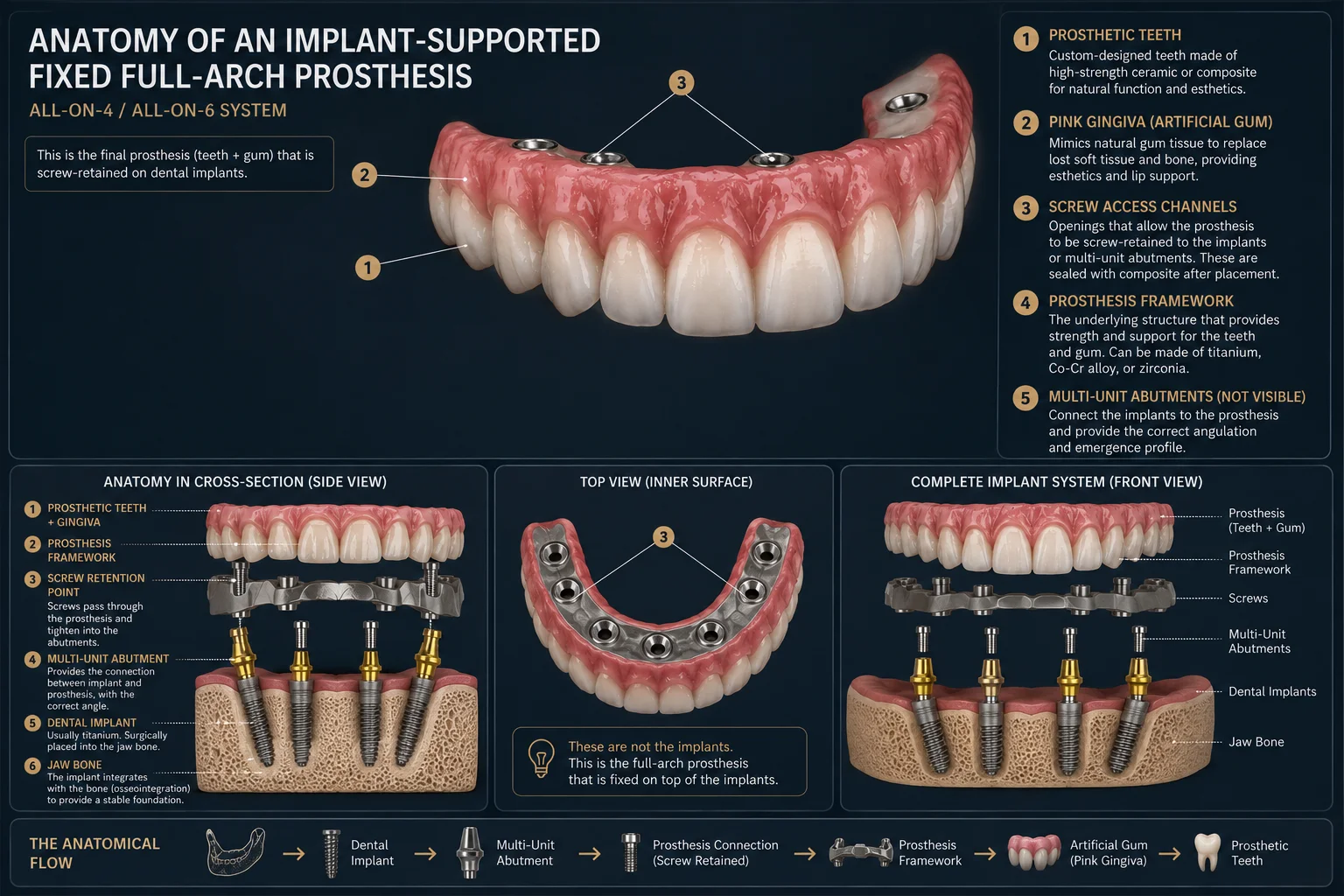
Where Nexwell's partner team fits
Nexwell is a medical tourism company. It does not treat patients; independent partner clinicians do. For full-arch cases, Nexwell's partner team offers a corticobasal route with a fixed bridge within 72 hours of surgery. The details, and who may be assessed for it, are on the 72-hour full mouth implants page.
The wider corticobasal implants guide explains how to vet any clinic offering this approach.
Whether you are a candidate is decided from your own CBCT scan and an examination. Some patients will be advised to take a conventional route, with or without bone grafting, or a zygomatic plan. That is a normal outcome of an assessment, not a failure of it.
If the profile above sounds like yours, the natural next step is the 72-hour page, where you can send your scan for a personal plan.
Questions to ask before you agree to a basal plan
Ask the clinic how many cases of your type it has treated and followed for more than three years, and ask to see the data rather than selected photos. Ask which exact implant models would be used in each position and why. Ask what the plan is if one implant fails, and whether the bridge can be removed. Ask who adjusts the bite after surgery and when.
Finally, ask what a conventional alternative would involve, so you can compare the two. A reputable team answers all of this in writing.
Sources
Every figure above comes from these papers and reviews. Each link opens the PubMed record.
1. Jani M, et al. Healthcare (Basel) 2022;10(4):598. PubMed 35455776, PMC9024819. 2. Patel KB, et al. Ann Maxillofac Surg 2025;15(1):56-60. PubMed 40765890, PMC12321181. 3. Lazarov A. Ann Maxillofac Surg 2019;9(1):78-88. PubMed 31293933, PMC6585197. 4. Patel K, et al.
Ann Maxillofac Surg 2021;11(1):64-69. PubMed 34522656, PMC8407620. 5. Ihde S, Ihde A. Considerations Regarding Dental Implant Surfaces, Bone Reaction and "Peri-implantitis". Ann Maxillofac Surg 2018;8(2):365-368. PubMed 30693267, PMC6327802. 6. Joshi M, et al.
Cureus 2026;18(7):e113703. PubMed 42670384, PMC13526232. 7. Diaz P, et al. BMC Oral Health 2022;22(1):449. PubMed 36261829, PMC9583568. 8. Abdunabi A, et al. J Appl Oral Sci 2019;27:e20180600. PubMed 31411262, PMC9648956. 9. Pałka ŁR, Lazarov A.
Ann Maxillofac Surg 2019;9(2):371-378. PubMed 31909018, PMC6933992. 10. Masaki C, et al. Treatment strategies for dental implant removal: a literature review. Jpn Dent Sci Rev 2024;60:120-127. PubMed 39444488, PMC11497076.
This page was prepared by the Nexwell Team on 31 October 2026. Medically reviewed by Dt. Mehmet Salih Yıldırım, DDS, PhD.
Frequently asked questions
Are basal implants the same as corticobasal implants?
In practice the terms overlap. Corticobasal and Strategic Implant describe the modern screw-type devices that anchor in cortical bone, mostly one-piece. Older lateral basal plates are a separate device. Ask the clinic for the exact implant models it plans to use.
Do these implants always avoid bone grafting?
No. They are designed to use dense cortical bone, which often removes the need for grafts, but whether that works depends on your scan. Some jaws still need a conventional or zygomatic plan. Treat any promise made before a CBCT scan with caution.
Can they cause peri-implantitis?
The Lazarov and Patel 2025 series, both from developer-linked teams, report none, and the one-piece, polished design gives a plausible reason. Follow-up was short, so zero cases is encouraging rather than proven. Good hygiene and regular checks still apply.
How long do basal implants last?
No one can give a reliable figure. The longest prospective report here covers up to 57 months (Lazarov 2019), another series reached 82 months at most with a mean under two years (Jani 2022), and a 20-year result exists only as a single case report. Ten-year data from independent teams are missing.
Is this suitable if I have diabetes or smoke?
Some studies included patients with diabetes (63 in Jani) and smokers (17 in Jani, 26 in Lazarov) (Jani 2022, Lazarov 2019), and Jani and Patel 2025 excluded patients on bisphosphonates or with recent radiotherapy, and Patel 2025 also excluded immune suppression (Patel 2025). Jani found no significant link between smoking and survival and reported a difference by diabetes status, but its table and text disagree on the direction, so the paper settles neither question. Your dentist and physician need to assess you individually.
What are the surgical risks and what does recovery look like?
In Patel 2021 (10 patients; Patel et al. 2021), complications included bruising that cleared in one to two weeks, temporarily reduced mouth opening after pterygoid placement, nasal bleeding and a broken drill. These are small series, so ask your surgeon for the risks specific to your plan.
How much do basal implants cost?
No figure is quoted here, because the price depends on the number of implants, the bridge material and what your scan shows. The dental implant cost guide explains how prices are built, and a case review gives you a personal plan.
Guide: The Complete Medical Tourism Handbook
Cost comparisons, clinic evaluation checklist, packing list & recovery tips. Everything you need to plan your treatment in Turkey.
Instant download. Your email is only used to send the guide and a few planning tips. No spam, unsubscribe anytime.
Related reading
dental-treatments
One-Piece vs Two-Piece Dental Implants: Micro-Gap and Peri-Implantitis Facts
One-piece vs two-piece dental implants compared: micro-gap, peri-implantitis, bendable necks and bridge flexibility, and what independent reviews found.
dental-treatments
Dental Implants Without Bone Grafting: Options, Evidence and Who Is Not a Candidate
Dental implants without bone grafting suit some patients: short, tilted, pterygoid, zygomatic and cortical-anchored types. See the evidence and its limits.
Medically reviewed by Dt. Mehmet Salih Yıldırım, D.D.S., PhD. Last reviewed October 2026