One-piece vs two-piece dental implants: what the micro-gap really changes
One-piece vs two-piece dental implants compared: micro-gap, peri-implantitis, bendable necks and bridge flexibility, and what independent reviews found.
Quick answer
One-piece vs two-piece dental implants: for suitable patients, a one-piece (monoblock) implant has no micro-gap and carries a rigid fixed bridge within days, while a two-piece implant offers more flexible bridge design. A randomized trial with 15 to 17 years of follow-up descriptively favoured the two-piece system, though that system was an earlier-generation design. Most other studies are observational, so suitability is decided by a CBCT scan and an examination.
Most patients never choose between these designs. The dentist does, and the reason is usually the bridge, not the bone. Still, the choice shapes how an implant is repaired, how it is loaded and what happens if something goes wrong. This guide explains the difference, tests the claims made for the monoblock design against the literature and says plainly where the evidence stops.
It is general information, not advice for your mouth.
One-piece vs two-piece dental implants: the core difference
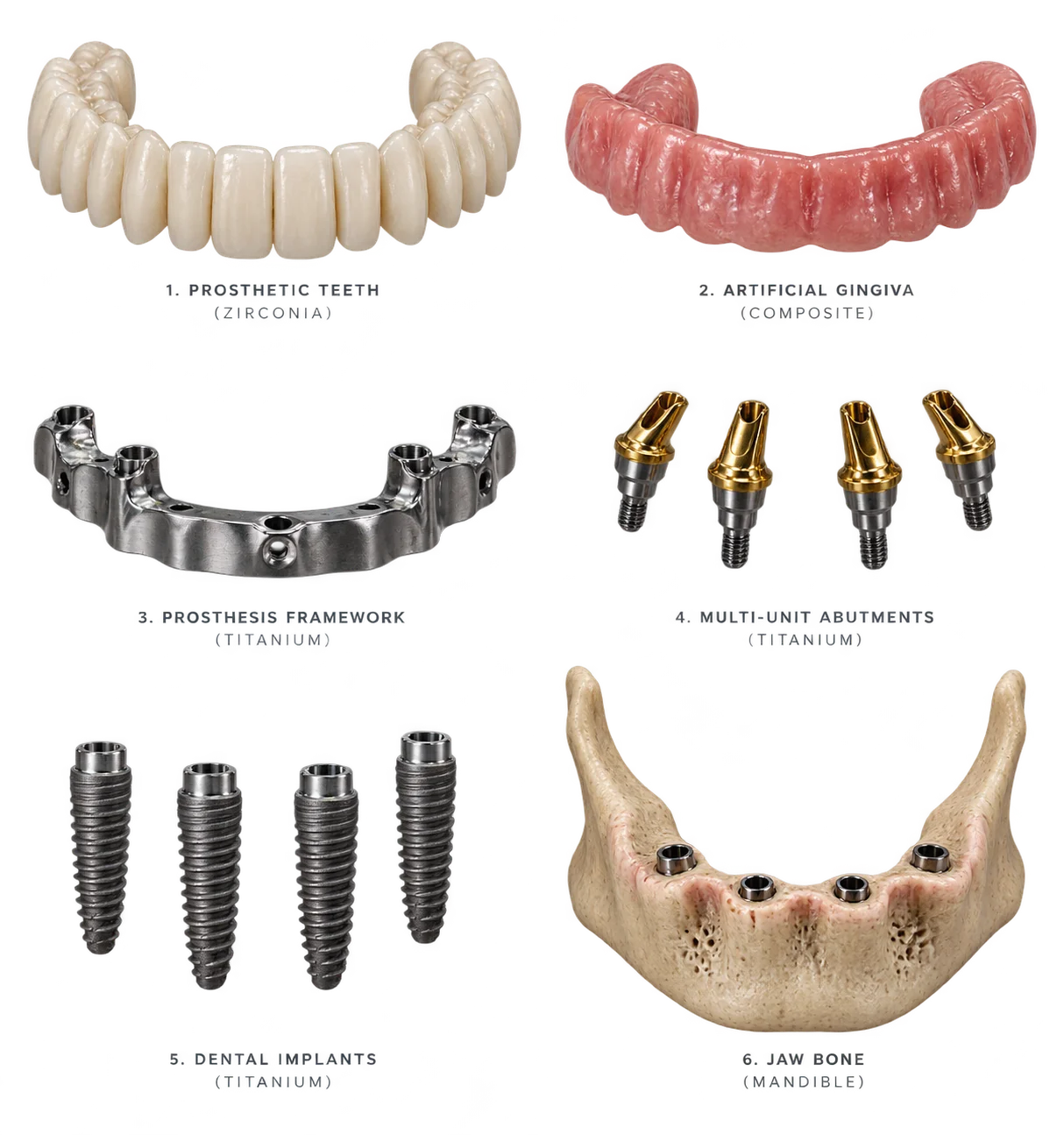
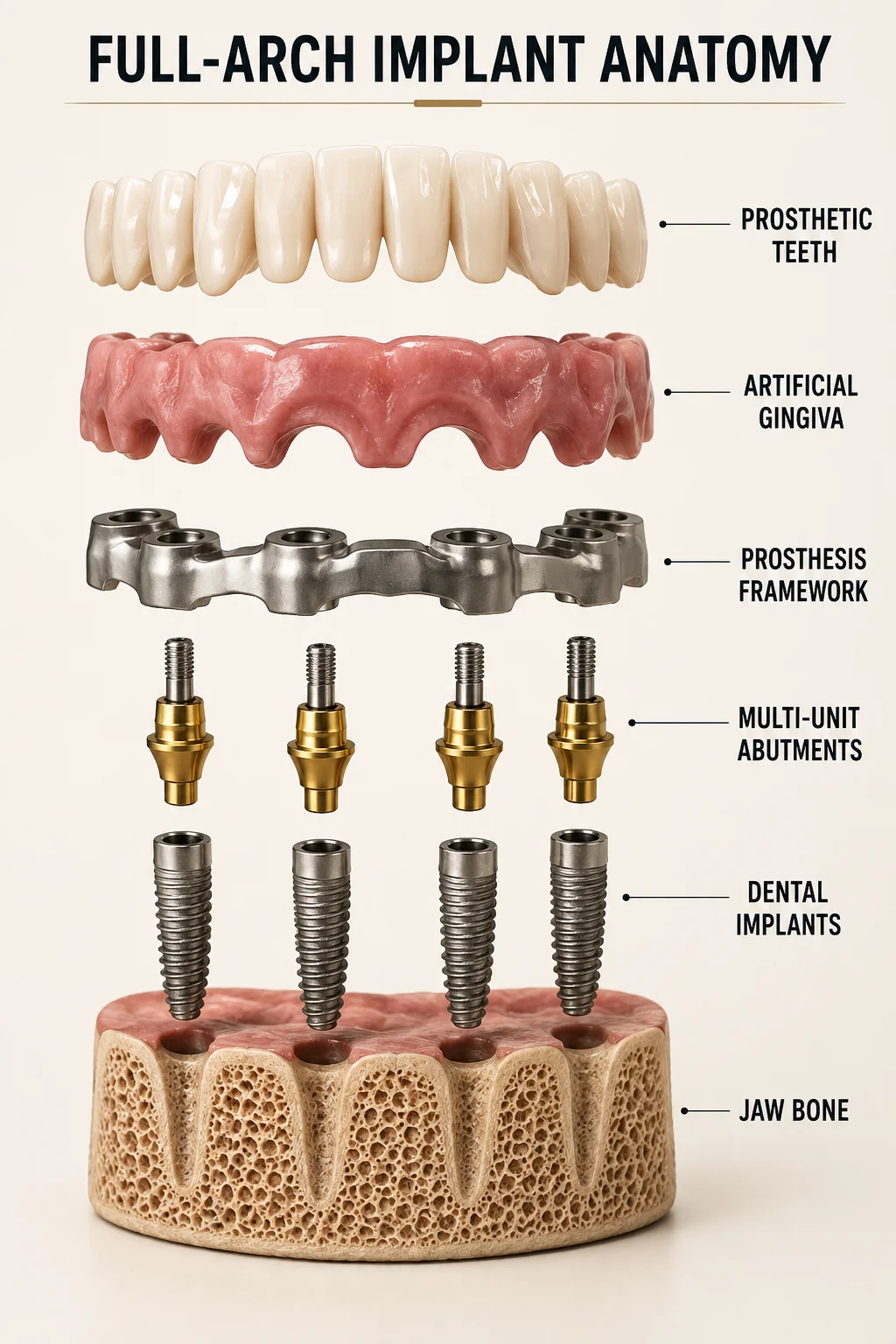
An implant restoration has two functional parts: the screw in the bone and the abutment that carries the crown or bridge. In a two-piece system they are separate components held together by a small internal screw. In a one-piece system, also called monoblock or single-piece, they are machined from one block of titanium. The part that sits in the bone and the part that sticks through the gum are the same body.
That single fact explains almost every trade-off. A two-piece implant can be placed, left to heal under the gum, and fitted later with an abutment of any angle or height, a flexibility described on our types of dental implants page. A one-piece implant goes into the bone with its abutment already attached, so the surgeon must place it in the right position and angle on the first attempt.
The bridge is built around what the surgeon achieved.
What the micro-gap is, and how much it matters
Where two parts meet, a hairline space remains. In two-piece implants this micro-gap sits near the bone crest. Laboratory and animal work links it with micromotion and bacterial leakage, and the authors of a 2017 meta-analysis of eight clinical studies describe it as the main negative influence on crest bone (Wang et al. 2017).
That is the strongest argument for one-piece designs.
The clinical evidence is thinner than the argument. A systematic review of animal and human studies, all at high risk of bias, found that crest bone changes differed by about 0.5 mm (weighted mean difference 0.479 mm) depending on where the gap sat relative to the bone crest, favouring a position below it.
It concluded that the effect of the connection type itself lacks documentation (Schwarz et al. 2014). So the micro-gap is real, but how much it matters in patients is not settled.
What independent reviews found
The table sets out the comparisons that could be checked against open full texts.
| Question | Source | Finding |
|---|---|---|
| What happens over 15 to 17 years? | Pirc et al. 2026, randomized trial, 39 patients and 95 implants at final review | Survival 91.8% with the one-piece system and 98.0% with the two-piece system, described without a statistical test; technical complications on 35.4% versus 5.8% of implants; the one-piece group kept more crestal bone |
| Zirconia: which design fails less? | Mohseni et al. 2023, 25 clinical studies, 4,017 zirconia implants | Failure 4.1% (157 of 3,818) for one-piece and 7.5% (15 of 199) for two-piece, log-rank p = 0.017; only 5% of the implants were two-piece |
| How common is peri-implantitis overall? | Diaz et al. 2022, 57 studies of implants in function for at least five years | 19.5% of patients and 12.5% of implants; the figure stays highly variable with the case definition |
Read the Pirc row with care. In the Zurich trial the one-piece arm was a Straumann implant, not a basal or bendable-neck design, and the two-piece arm was an earlier-generation Brånemark implant. The authors warn against applying the results to modern two-piece systems, and 21 of the 60 patients missed the final visit (Pirc et al. 2026).
The zirconia row is a different material and a lopsided comparison, with 199 two-piece implants against 3,818 one-piece, and most cases were followed for only a few years. Neither row shows that one design lasts longer in titanium today.
How to read the evidence on monoblock implants
The two largest developer-linked series (Lazarov 2019 and Patel 2025) report no peri-implantitis. In Lazarov's series of 5,100 implants followed for up to 57 months, none was reported (Lazarov 2019).
Those are encouraging results, with the usual limits of observational work: the patients were followed rather than randomised, and part of the follow-up was a patient interview. Independent long-term comparisons are still limited.
The randomized Zurich trial gives a less favourable picture. After 15 to 17 years, peri-implantitis was diagnosed in 12 of 65 one-piece implants (7 of 30 patients) and 8 of 86 two-piece implants (5 of 30 patients), reported descriptively without a statistical test, and the implants lost in both arms were lost to peri-implant disease.
The abstract reports higher rates in the one-piece group, while the discussion calls the prevalence in the two groups comparable and warns that too few patients remained to detect differences (Pirc et al. 2026).
The finish of the neck seems to matter too. In the developer's report on a single patient followed for 20 years, polished shafts kept their bone level while roughened shafts developed crater-like loss (Ihde and Ihde 2018).
Fixed angles and bendable necks
The practical limit of a one-piece implant is its angle. If two implants in a bridge are not parallel, the abutments will not line up. A two-piece system solves this with angled abutments. A one-piece system solves it by bending the neck during surgery, a step the surgeon plans from the scan.
Bending is built into some designs. One prospective cohort found no significant effect on survival: on radiographic follow-up 97.5% of bent implants survived against 96.1% of unbent ones (p = 0.413), and the difference was also not significant by clinical inspection or patient report (Lazarov 2019).
In a 2019 series by Pałka and Lazarov, which appears to describe the same 87 patients as the Lazarov cohort, 376 of 1,019 implants (36.9%) had bent necks (Pałka and Lazarov 2019). The two papers are one data set, not two confirmations. So bending is routine in these protocols, which is why accurate planning, a well-adjusted bite (occlusion) and regular check-ups matter.
Because the abutment is fixed, the position chosen at surgery also shapes the final bridge.
Tool · instant estimate · no sign-up
How much would your implants cost in Turkey?
Enter the quote you were given at home and see your typical all-inclusive Turkey price for All-on-4, All-on-6 or full mouth implants, plus your estimated saving, instantly.
Who a one-piece implant suits
A one-piece design suits adults who want a rigid, fixed bridge within days, especially when bone is thin or sloping and a graft would add months. It also suits people who want to avoid an abutment screw that can loosen, and whose dentist has real experience with the system. For a suitable patient the benefit is a shorter route to fixed teeth with fewer parts to maintain.
What the choice means for your bridge
One-piece implants are usually restored with a cemented bridge, locked together in a rigid splint soon after surgery. This removes the abutment screw, but it also makes the bridge hard to remove.
In the largest recent series, retrieving a cemented prosthesis was described as painful and time-consuming, and the authors suggested screw-retained designs instead (Patel et al. 2025).
A 2022 review of prosthetic failures adds that excess cement is difficult to remove even at shallow margins, and recommends screw retention to reduce that risk (Sailer et al. 2022).
Two-piece implants offer screw-retained bridges that a dentist can take off for cleaning or repair, which also helps when a single implant is lost. When a fixed bridge can be placed on two-piece implants depends on the protocol, either after a healing period or with immediate loading, which our immediate loading guide covers. Neither approach is simply better.
The right question is which one fits the plan for your jaw. Clinics try to manage the limits of both designs in the same way: planning from a CBCT scan, bite adjustment after surgery and control appointments, plus a clear agreement on how the bridge is fixed.
How placement differs: one stage or two
A one-piece implant is always a one-stage implant, because the abutment is part of it and passes through the gum from day one. A two-piece implant can follow either route.
In two-stage surgery the implant is placed below the bone crest and soft tissue and the flap is closed over a cover screw; in one-stage surgery a healing abutment is placed at the time of surgery (Gheisari 2017).
A randomized trial of 310 implants in 140 patients measured 0.76 mm and 0.842 mm of marginal bone loss six months after loading with the one-stage and two-stage approaches, and the authors found no significant difference (Gheisari 2017). It came from one centre, followed patients briefly, and the groups were unequal in size.
Flapless placement, with no gum flap lifted, is a separate question. A meta-analysis of 23 publications found failures 1.75 times as likely with flapless surgery (95% CI 1.07 to 2.86), but 16 studies were at high risk of bias and the result changed when high-risk and low-risk studies were pooled separately (Chrcanovic 2014).
What goes wrong: screws, cement and fractures
Screw loosening is the most frequent technical problem of single implant crowns, with a cumulative five-year rate of 8.8%, while abutment screw fracture is rare. Rates fell after 2000, from 3.9% to 26.2% in earlier studies to 3.1% to 10.8% in later ones, but no design has removed the problem (Sailer 2022).
A one-piece implant has no abutment screw, which removes that failure point and moves the weak spot to the cemented bridge: Patel 2025 recorded fractures of ceramic and acrylic bridges and decementation of bridges.
Implant fracture is the other concern. In a review of zirconia implants, 26 of 4,017 (0.65%) fractured, most of them narrow-diameter, and fractures were more frequent when the one-piece abutment had been ground with a drill (18 of 746, 2.4%) than when it had not (8 of 3,245, 0.2%) (Mohseni 2023). The sources cited here give no fracture rate for one-piece titanium implants.
The Zurich trial's higher technical complication rate for one-piece implants (35.4% against 5.8%) does not show that modern designs break more often.
Ceramic (zirconia) implants: one-piece or two-piece
Most zirconia implants in clinical studies are one-piece. In a 2023 review of 25 studies (4,017 implants in 2,083 patients), 95.0% were one-piece and 5.0% two-piece, and ten-year cumulative survival was 95.1%. The authors caution that most cases were followed for only a few years and that zirconia has been studied less than titanium.
Two-piece zirconia implants failed more often (7.5% against 4.1%, p = 0.017), though that rests on 199 implants. The authors suggest manufacturers were at first wary that thin connection parts would tolerate load, which would explain why the one-piece type came first (Mohseni 2023).
Ask a clinic offering ceramic implants which model it uses and what follow-up data exist for that model. Our zirconia vs titanium guide covers the material question.
Which design tends to fit which situation
This table is a map for the conversation with your dentist. The "Why" column is general clinical reasoning, not a finding from the studies cited here, except where a source is linked. The final call depends on your scan, your bite and your dentist's experience with each system.
| Situation | Leans toward | Why |
|---|---|---|
| Single front tooth with an aesthetic demand | Two-piece | Angled and custom abutments, screw-retained crown |
| Full arch fixed in days, narrow or sloping ridge | One-piece may fit | Fixed abutments, rigid splint, bendable neck |
| Plan to remove the bridge for cleaning or repair | Two-piece | Screw-retained design |
| Previous periodontitis | Either, with strict hygiene | A one-piece bicortical series of 87 patients, 77 of them with periodontitis, reported 97.0% survival at 35 months (Pałka and Lazarov 2019); it appears to be the same cohort as Lazarov 2019 |
| Narrow implant in thin bone | Case by case | The Jani series found 3.2 mm one-piece implants had the lowest survival on radiographic follow-up (96.6%, against 99.4% by clinical inspection) (Jani et al. 2022) |
How this connects to Nexwell's partner team
Nexwell coordinates treatment and does not perform it. The 72-hour route offered by Nexwell's partner team is built on the IHDE corticobasal concept, whose devices in the cited studies are mostly one-piece.
The 72-hour full mouth implants page explains who may be assessed for it, and the corticobasal guide shows how to vet any clinic offering it. For cases that suit a conventional two-piece plan, see All-on-4 and All-on-6.
If a fixed bridge within days sounds right for you, the 72-hour page is the natural next step. If you are weighing the whole range of implant options, the full mouth implants overview is the better starting point.
Questions to ask your dentist
Ask which system is planned and why that design suits your case. Ask how the bridge is fixed and whether it can be removed. Ask what happens if one implant fails. Ask the clinic's own record: how many implants of that type it has placed, and how many it has followed for five years. A clear written answer is a good sign. A vague one is information too.
Sources
1. Pirc M, et al. Clin Implant Dent Relat Res 2026;28(3):e70157. PubMed 42126189, PMC13170413. 2. Mohseni P, Soufi A, Chrcanovic BR. Clin Oral Investig 2023;28(1):15. PubMed 38135804, PMC10746607. 3. Diaz P, et al. BMC Oral Health 2022;22(1):449. PubMed 36261829, PMC9583568. 4.
Schwarz F, Hegewald A, Becker J. Clin Oral Implants Res 2014;25(4):417-425. PubMed 23782338, PMC4232321. 5. Wang QQ, et al. PLoS One 2017;12(10):e0186385. PubMed 29049323, PMC5648164. 6. Sailer I, et al. Periodontol 2000 2022;88(1):130-144. PubMed 35103329, PMC9305548. 7.
Gheisari R, et al. J Dent (Shiraz) 2017;18(4):272-276. PubMed 29201970, PMC5702431. 8. Chrcanovic BR, et al. PLoS One 2014;9(6):e100624. PubMed 24950053, PMC4065043. 9. Lazarov A. Ann Maxillofac Surg 2019;9(1):78-88. PubMed 31293933, PMC6585197. 10. Patel KB, et al.
Ann Maxillofac Surg 2025;15(1):56-60. PubMed 40765890, PMC12321181. 11. Ihde S, Ihde A. Ann Maxillofac Surg 2018;8(2):365-368. PubMed 30693267, PMC6327802. 12. Pałka ŁR, Lazarov A. Ann Maxillofac Surg 2019;9(2):371-378. PubMed 31909018, PMC6933992. 13. Jani M, et al.
Healthcare (Basel) 2022;10(4):598. PubMed 35455776, PMC9024819.
Prepared by the Nexwell Team on 31 October 2026. Medically reviewed by Dt. Mehmet Salih Yıldırım, DDS, PhD.
Frequently asked questions
Which lasts longer, a one-piece or a two-piece implant?
No reliable difference has been shown for titanium implants. The longest randomized trial followed patients for 15 to 17 years: 91.8% of one-piece and 98.0% of two-piece implants survived, but the authors made no formal statistical comparison, 21 of 60 patients missed the final visit and the two-piece system was an earlier-generation design (Pirc et al. 2026). In zirconia, a 2023 review found more failures among two-piece implants (7.5% against 4.1%), based on only 199 two-piece implants (Mohseni et al. 2023). Bone, bite, hygiene and the surgeon's technique matter as well.
Is the micro-gap a real problem?
It is documented in the laboratory and in animal studies, where bacterial leakage and micromotion at the gap are linked with crest bone loss. In patients the evidence is thinner: a systematic review of animal and human studies, all at high risk of bias, found about 0.5 mm less crest bone change when the gap sat below the crest, and found the effect of connection type undocumented (Schwarz et al. 2014). How much it matters in modern clinical practice is not settled.
Can a one-piece implant be bent, and is that safe?
Some designs allow bending of the neck during surgery to align a bridge. One cohort found no significant effect on survival (Lazarov 2019), and a series that appears to cover the same patients reported bent necks in 376 of 1,019 implants (36.9%) (Pałka and Lazarov 2019). Bending is routine in these protocols, so planning and bite adjustment matter. Ask the clinic for its own bending and failure data.
Which design is better for a full arch of teeth?
Both are used. Two-piece systems are the usual base for All-on-4 and All-on-6 plans, as our zirconia vs titanium guide notes, while one-piece systems suit protocols that load a rigid fixed bridge within days. The choice depends on bone, angles and the prosthetic plan. A scan-based assessment decides, not the brand.
Can a one-piece implant bridge be taken off later?
Usually not easily. These bridges are typically cemented, and a 2025 series described removal as painful and time-consuming (Patel et al. 2025). Screw-retained bridges on two-piece implants can be removed by the dentist. Ask before surgery how the bridge will be fixed.
Are one-piece implants more likely to break?
The sources cited here give no fracture rate for one-piece titanium implants. In a review of zirconia implants, 26 of 4,017 (0.65%) fractured, mostly narrow-diameter ones, and fractures were more common when the one-piece abutment had been ground with a drill (2.4% against 0.2%) (Mohseni 2023). Screw loosening, the most frequent technical problem of single implant crowns (8.8% over five years in a 2022 review, Sailer 2022), concerns abutment and prosthetic screws, which a one-piece implant avoids at the abutment level. Cemented bridges on one-piece implants can fracture, as a 2025 series recorded (Patel 2025).
Are zirconia implants better as one-piece or two-piece?
Most zirconia implants studied are one-piece. A 2023 review of 25 studies found a higher failure rate for two-piece zirconia (7.5% against 4.1%), but only 199 of 4,017 implants were two-piece, so the gap is uncertain (Mohseni et al. 2023). Ask which model is planned and what follow-up data exist for it. The zirconia vs titanium guide covers the material question.
How much does each type cost?
No figure is quoted here, because the price depends on the number of implants, the bridge and your scan, not only on the design. The dental implant cost guide explains how prices are built, and a case review gives you a personal plan.
Guide: The Complete Medical Tourism Handbook
Cost comparisons, clinic evaluation checklist, packing list & recovery tips. Everything you need to plan your treatment in Turkey.
Instant download. Your email is only used to send the guide and a few planning tips. No spam, unsubscribe anytime.
Related reading
dental-treatments
Basal Implants vs Conventional Implants: What the Evidence Shows
Basal implants anchor in dense cortical bone for severe bone loss. See what studies report, where the evidence is thin, and who should stay conventional.
dental-treatments
Dental Implants Without Bone Grafting: Options, Evidence and Who Is Not a Candidate
Dental implants without bone grafting suit some patients: short, tilted, pterygoid, zygomatic and cortical-anchored types. See the evidence and its limits.
Medically reviewed by Dt. Mehmet Salih Yıldırım, D.D.S., PhD. Last reviewed October 2026