Dental implants without bone grafting: which options exist, what the evidence says, and who should not try
Dental implants without bone grafting suit some patients: short, tilted, pterygoid, zygomatic and cortical-anchored types. See the evidence and its limits.
Quick answer
Dental implants without bone grafting can give suitable patients fixed teeth in days instead of months, using short, tilted, pterygoid, zygomatic or cortical-anchored implants that rely on the bone that remains. Most evidence is observational, and your CBCT scan and examination decide which route fits.
Being told you need a bone graft first can feel like a dead end, because grafts add months and an extra operation. Several alternatives exist, and some of them have solid research behind them. None is a shortcut. Each trades the graft for something else: harder surgery, a different bridge design or a thinner evidence base.
This guide lays the options side by side, says who should not try them and leaves the choice to your scan and your surgeon. It is general information, not a diagnosis.
Dental implants without bone grafting: the main options
Grafting rebuilds missing bone so a standard implant can sit in it. The alternatives work the other way round: they pick an implant that fits the bone you still have, or reach bone in a different place. The table summarises what reviews report.
| Option | Where it applies | What the evidence says | Main limit |
|---|---|---|---|
| Short implants | Reduced bone height in the back jaws | In 7 randomised trials with 393 patients, survival did not differ significantly from longer implants placed with a sinus lift, with fewer biological complications (Alenezi et al. 2025) | Trials covered only atrophic posterior maxillae |
| Tilted implants | Posterior implants tilted to avoid the sinus or nerve, as in All-on-4 plans | In 25 studies, survival of tilted and axial implants did not differ significantly, with implant survival of 94% to 98% over 72 to 132 months (Gaonkar et al. 2021) | None of the studies was a randomised trial |
| Pterygoid implants | Back of the upper jaw | In 38 studies of pterygoid and tuberosity implants (3,053 pterygoid), ten-year cumulative survival of pterygoid implants was 92.5%, with failures concentrated in the first year (Raouf and Chrcanovic 2024) | Many studies were retrospective, and confounders such as smoking and bruxism were not controlled |
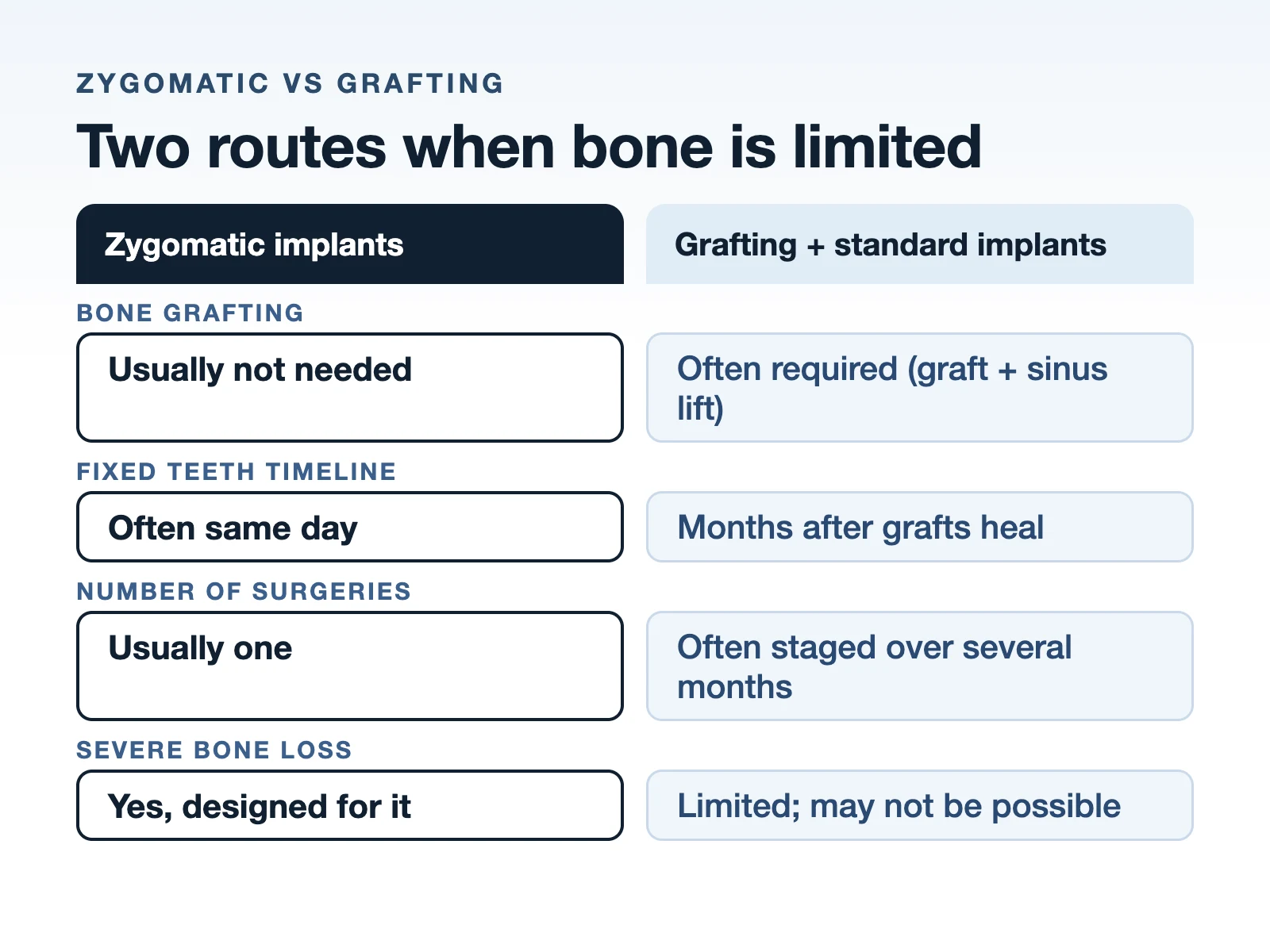
| Zygomatic implants | Severely resorbed upper jaw | 18 case series with 1,349 zygomatic implants in 623 patients: 96.2% survival at a mean of 75.4 months (Brennand Roper et al. 2023). A 2021 meta-analysis found, in its own comparison of 31 studies including both, no significant difference from conventional implants (odds ratio 1.33, 95% CI 0.79 to 2.23), although its abstract reports a different figure (Gutiérrez Muñoz et al. 2021) | Sinusitis was the most frequent biological complication: 14.2% over a mean of 65.4 months in one pooled analysis and 4.7% in another, so the figure depends on how it is counted; needs an experienced surgeon |
| One-piece compression-screw and cortical-anchored (basal) implants | Bone loss in either jaw | 1,057 one-piece compression-screw implants, 98.5% in function over a mean of 22 months (Jani et al. 2022) | Short follow-up; none of the cited studies is a randomised comparison |
The last row is covered in depth in our basal implants guide and the wider corticobasal guide.
How to read the evidence
The short-implant result comes from randomised trials, the strongest design. The zygomatic result comes from case series: all 18 studies in the long-term review were prospective or retrospective case series, and its authors state that no randomised trial was included and that results need caution because of the lack of high-quality evidence (Brennand Roper et al. 2023).
Pterygoid and basal implants rest on retrospective cohorts and small prospective studies, so long-term randomised data are limited.
The pterygoid review adds a useful detail: failures were concentrated in the first year of follow-up, and implants splinted to other implants may have done better than those that were not (Raouf and Chrcanovic 2024). Problems mostly appeared early, which is why the first months of follow-up matter.
Bone loss after extraction and how much bone you need
Bone does not stay put after a tooth is removed. A narrative review of ridge preservation describes ridge resorption as faster during the first six months after extraction, and states that when the socket is not grafted, major ridge resorption occurs, first in height and then in width (Pagni et al. 2012).
It is not a pooled analysis and gives no figure that applies to your jaw.
For planning, two things follow. Because the ridge changes most early, the timing of implant planning after an extraction is worth discussing with your surgeon. And "how much bone do I need" depends on the implant chosen: short implants lower the height required and narrow implants lower the width required. Only a CBCT scan shows your own ridge.
Narrow and mini implants
Narrow-diameter implants are sometimes offered as an alternative to adding bone width. A 2021 systematic review of 15 studies (773 patients, 1,245 implants, follow-up of at least 36 months) found 97% survival and a mean marginal bone loss of 0.821 mm, and concluded that narrow implants are a predictable option (González-Valls et al. 2021).
The review pooled diameters below 3.0 mm ("mini-implants"), 3.0 to 3.25 mm and 3.3 to 3.5 mm, so its figure cannot tell you how a mini-implant alone performs.
A 2019 review of narrow implants (3.3 mm or less) carrying single crowns found no difference in longevity from standard implants, with success of 93.8% to 100% over at most three years. The extra bone loss in its pooled analysis was absent when only randomised trials were considered (Telles et al. 2019).
Telles flags short follow-up, and both reviews note methodological heterogeneity. Narrow implants are usually used in very atrophic jaws, so they are a compromise, not a general graft substitute. Ask which diameter is planned and why.
Tool · instant estimate · no sign-up
How much would your implants cost in Turkey?
Enter the quote you were given at home and see your typical all-inclusive Turkey price for All-on-4, All-on-6 or full mouth implants, plus your estimated saving, instantly.
When grafting remains the better route
Grafting and sinus lifts are long-established, and some cases are better served by them. A thin ridge in the aesthetic zone may need added bone volume to hold the gum line, and a single missing tooth rarely calls for a zygomatic implant. Our bone graft guide and sinus lift guide explain those cases.
The short-implant trials, for their part, covered only atrophic back-of-the-upper-jaw sites, so they do not show the same result in every jaw.
Who graft-avoiding plans suit
These routes are usually considered for adults with significant bone loss who have been told they need a graft or sinus lift, long-term denture wearers who want fixed teeth, and people whose earlier grafts did not take. They suit patients who want fewer operations and a shorter wait, who keep their mouths clean and whose general health is stable.
For a suitable patient the gain is real: no graft stage and, in some protocols, a fixed bridge within about three days.
Who should not try these options, or needs separate assessment
The studies above exclude or flag several groups. Treat the list as questions for your dentist and physician, not as a self-test.
| Situation | Why it matters |
|---|---|
| Bisphosphonate treatment | Excluded in the Jani and Patel 2025 cohorts; needs specialist advice |
| Recent radiotherapy | Excluded in both cohorts (head and neck, 6 months, in Jani; 2 years in Patel 2025) (Jani 2022, Patel 2025) |
| Immune suppression | Excluded in Patel 2025 (Patel et al. 2025) |
| Uncontrolled diabetes, active gum disease or infection | Treated or controlled first; see our periodontal guide |
| Heavy clenching or one-sided chewing | Overload was linked with failures in the cohorts above |
| Very dense or very soft bone | Compression-screw designs are not indicated for D1 or D4 bone (Ihde and Ihde 2018) |
| Previous sinus problems | Zygomatic and trans-sinus routes carry sinusitis risk |
Clinics try to manage these risks through planning on a CBCT scan, choosing the route for each site, adjusting the bite after surgery and holding control appointments.
How soon can teeth be fitted?
Skipping a graft removes one waiting period, and some protocols place a fixed bridge within about three days, using cortical anchorage and rigid splinting. Whether that is possible for you depends on the stability of each implant, how the bridge is splinted and your bite, all judged on the scan and at surgery.
A systematic review of immediately loaded upper full-arch bridges found limited trial evidence and asked for better trials; it does not cover severely atrophied upper jaws (Abdunabi et al. 2019). Our immediate loading guide sets out the details.
Matching the route to the problem
Use the table to prepare questions, not to self-select.
| Where the bone is missing | Routes to ask about | Questions to raise |
|---|---|---|
| Back of the upper jaw only | Short, tilted or pterygoid implants, or a sinus lift | Which has the better record in this surgeon's hands? |
| Most of the upper jaw | Zygomatic, or grafting with standard implants | How many zygomatic cases has the surgeon treated? |
| Thin lower back ridge | Short implants or narrow implants | Is there enough width and distance to the nerve? |
| Both jaws, long-term denture wearer | Cortical-anchored implants, All-on-4 style plans, or grafting | What if one implant fails? Can the bridge come off? |
| One front tooth | Usually conventional with grafting if needed | Will the gum line hold without added bone? |
Where Nexwell's partner team fits
Nexwell is a medical tourism company. It coordinates treatment and independent clinicians perform it. For full-arch cases, Nexwell's partner team offers a corticobasal route with a fixed bridge within 72 hours of surgery, assessed after a CBCT scan: see the 72-hour full mouth implants page.
For severe upper-jaw loss, there is also the zygomatic implants page and the zygomatic planning guide. Some patients will be advised to graft after all, and that is a legitimate result of an assessment.
If you are told you need a graft first, the 72-hour page is the natural next step: send your scan for a case review and a personal plan.
Sources
1. Alenezi AT, et al. Cureus 2025;17(7):e89103. PubMed 40747176, PMC12311554. 2. Gaonkar SH, et al. J Indian Prosthodont Soc 2021;21(1):3-10. PubMed 33835063, PMC8061444. 3. Raouf K, Chrcanovic BR. J Clin Med 2024;13(15):4544. PubMed 39124809, PMC11312960. 4. Brennand Roper M, et al.
Int J Implant Dent 2023;9(1):21. PubMed 37405545, PMC10322814. 5. Gutiérrez Muñoz D, et al. Biology (Basel) 2021;10(7):601. PubMed 34209770, PMC8301194. 6. Jani M, et al. Healthcare (Basel) 2022;10(4):598. PubMed 35455776, PMC9024819. 7. Patel KB, et al.
Ann Maxillofac Surg 2025;15(1):56-60. PubMed 40765890, PMC12321181. 8. Ihde S, Ihde A. Ann Maxillofac Surg 2018;8(2):365-368. PubMed 30693267, PMC6327802. 9. Abdunabi A, et al. J Appl Oral Sci 2019;27:e20180600. PubMed 31411262, PMC9648956. 10. Pagni G, et al.
Int J Dent 2012;2012:151030. PubMed 22737169, PMC3378971. 11. González-Valls G, et al. Materials (Basel) 2021;14(12):3234. PubMed 34208369, PMC8231146. 12. Telles LH, et al. PLoS One 2019;14(11):e0225046. PubMed 31710656, PMC6844460.
Prepared by the Nexwell Team on 31 October 2026. Medically reviewed by Dt. Mehmet Salih Yıldırım, DDS, PhD.
Frequently asked questions
Can I really get dental implants without bone grafting?
For some patients, yes. Short, tilted, pterygoid, zygomatic and cortical-anchored implants are all used to avoid grafts. Whether one fits you depends on where your bone is missing and how much remains, which only a CBCT scan and an examination can show.
Which graft-avoiding option has the strongest evidence?
Short implants in the back jaws, because randomised trials found no significant survival difference from longer implants with a sinus lift (Alenezi et al. 2025). For tilted, pterygoid, zygomatic and cortical-anchored implants the evidence is observational, and the sources cited here do not rank them against each other.
Is a zygomatic implant safer than a sinus lift?
Not necessarily. Zygomatic implants have high reported survival, but in a 2023 meta-analysis sinusitis was the most frequently reported biological complication, at 14.2% over a mean of 65.4 months, and all the studies were case series (Brennand Roper et al. 2023). They suit severe upper-jaw loss and an experienced surgeon, not ordinary cases.
Does skipping the graft mean I get fixed teeth the same day?
No. Skipping the graft removes one stage, but the loading plan depends on each implant's stability, the bridge and your bite. Ask what is planned for your case and what happens if an implant does not hold.
Are mini implants a good way to avoid a bone graft?
Possibly in selected cases, but the evidence has limits. A 2021 systematic review pooled narrow implants (under 3.0 mm to 3.5 mm) and found 97% survival at three years or more, but it could not isolate mini-implants (González-Valls et al. 2021). A 2019 review found no longevity difference for narrow implants carrying single crowns over up to three years (Telles et al. 2019). Telles flags short follow-up, and both reviews note methodological heterogeneity. Ask which diameter is planned and why.
Is it cheaper to avoid a graft?
Sometimes the total plan is simpler, but no figure is quoted here because the price depends on the number of implants and the bridge. The dental implant cost guide explains how prices are built, and a case review gives you a personal plan.
Guide: The Complete Medical Tourism Handbook
Cost comparisons, clinic evaluation checklist, packing list & recovery tips. Everything you need to plan your treatment in Turkey.
Instant download. Your email is only used to send the guide and a few planning tips. No spam, unsubscribe anytime.
Related reading
dental-treatments
Basal Implants vs Conventional Implants: What the Evidence Shows
Basal implants anchor in dense cortical bone for severe bone loss. See what studies report, where the evidence is thin, and who should stay conventional.
dental-treatments
One-Piece vs Two-Piece Dental Implants: Micro-Gap and Peri-Implantitis Facts
One-piece vs two-piece dental implants compared: micro-gap, peri-implantitis, bendable necks and bridge flexibility, and what independent reviews found.
Medically reviewed by Dt. Mehmet Salih Yıldırım, D.D.S., PhD. Last reviewed October 2026