Medically reviewed by Dt. Tunç Berge, MSc: Esthetic Dentistry & Implantology. Last reviewed June 2026
Dental Treatment in Turkey vs Germany: Cost, Quality and What to Weigh
- TEMOS-accredited clinics
- JCI-accredited hospitals
- Board-certified surgeons and a licensed clinical team
- 3,000+ international patients treated
A NexWell comparison of dental treatment in Turkey versus Germany: indicative cost ranges for implants, crowns, veneers and All-on-4, an honest look at accreditation and sterilisation standards, the real trade-offs around travel, aftercare and language, and a clear framework for deciding which route fits your case.
Written quote from a NexWell coordinator, usually within 24 hours.

Quick answer
A NexWell comparison of dental treatment in Turkey versus Germany: indicative cost ranges for implants, crowns, veneers and All-on-4, an honest look at accreditation and sterilisation standards, the real trade-offs around travel, aftercare and language, and a clear framework for deciding which route fits your case.
Why People Compare Turkey and Germany for Dental Work
Germany has one of the most respected dental systems in the world. Training is rigorous, regulation is strict, and the standard of care patients receive at home is high. So when someone in Germany starts looking at treatment in Turkey, it is rarely because they doubt German dentistry: it is almost always because of one number: the bill.
German statutory health insurance covers basic, medically necessary dental care, but it contributes only a fixed allowance toward crowns, bridges and prosthetics, and it does not cover cosmetic work at all.
For a larger case: several dental crowns, a set of veneers, multiple dental implants or a full-arch restoration: the patient's own share of the cost in Germany can run into five figures. That gap is what sends people to compare.
Turkey has built a large, export-oriented dental sector around exactly this audience, particularly German-speaking patients, with clinics in Istanbul, Antalya and Izmir geared toward international visitors. The pitch is straightforward: comparable materials and brand-name components at a fraction of the price, often combined with a short trip.
Direct flights from German cities are frequent and inexpensive, which makes the logistics realistic in a way that flying to North America never would be.
This page is not an argument that one country is better than the other. Germany offers proximity, continuity of care and the protection of a familiar legal and regulatory system. Turkey offers cost savings that can be substantial for the right case.
German statutory health insurance covers basic, medically necessary dental care, but it contributes only a fixed allowance toward crowns, bridges and prosthetics, and it does not cover cosmetic work at all.
The honest answer to "which is better" depends on the size of your treatment, your tolerance for travel, and how much aftercare your case is likely to need, which is exactly what the rest of this guide works through.
Cost Compared: Indicative Ranges
| Cost is the headline reason patients compare the two countries, so it is worth being precise about what the numbers do and do not mean. The figures below are indicative ranges drawn from typical private fees, not quotes. German prices reflect private (non-insured) treatment; Turkish prices reflect typical international-patient fees in established clinics. Real costs depend on your case, the materials chosen and the clinic, and only a written, itemised quote after an examination is reliable. | Treatment | Germany (indicative) |
|---|---|---|
| Turkey (indicative) | Single [dental implant](/dental-implants-in-turkey) (implant + abutment + crown) | EUR1,800-EUR3,500 |
| EUR600-EUR1,200 | [Dental crown](/dental-crowns-turkey) (porcelain / zirconia, per unit) | EUR500-EUR1,000 |
| EUR150-EUR350 | [Veneers](/laminate-veneers-in-turkey) (per tooth) | EUR700-EUR1,400 |
| EUR200-EUR450 | [All-on-4](/all-on-4-turkey) (per arch, fixed bridge) | EUR9,000-EUR18,000 |
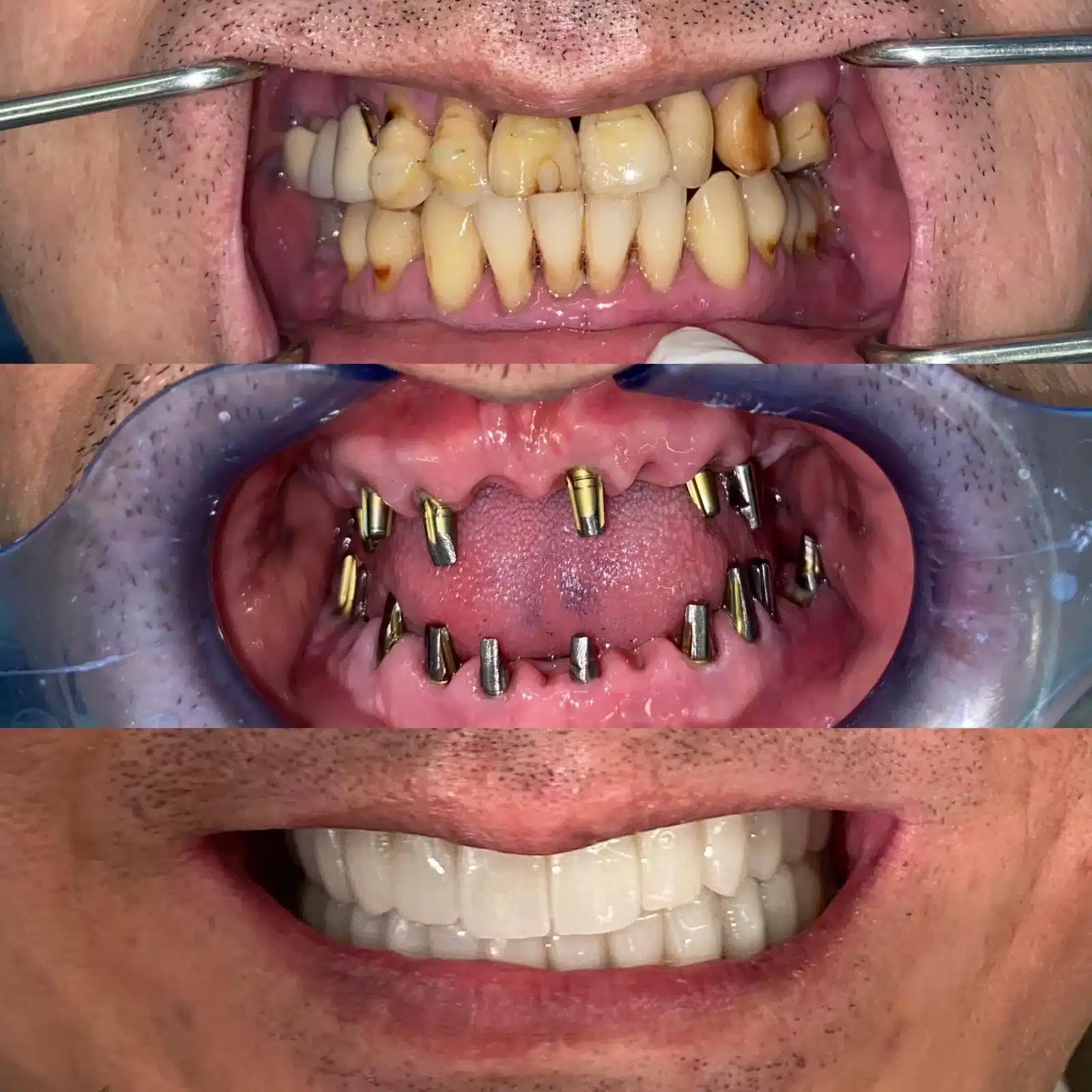
| EUR3,500-EUR7,000 | The pattern is consistent across procedures: Turkish fees commonly land at roughly a third to half of the German private equivalent, and the gap widens on larger cases because labour and laboratory costs make up more of the total. A single filling rarely justifies a trip; a full-arch case such as [All-on-6](/all-on-6-turkey) or [full mouth dental implants](/full-mouth-dental-implants-turkey), or a multi-tooth [Hollywood smile](/hollywood-smile) design, is where the difference becomes large enough to weigh against the cost of travel. | Two cautions matter here. First, a low headline price is only meaningful if it is itemised: a quote should name the implant system: patients can ask how it compares across [dental implant brands](/dental-implant-brands-compared): the [abutment](/dental-implant-abutment-explained), the crown or bridge material, any [bone graft](/bone-graft-for-dental-implants) or [sinus lift](/sinus-lift-for-dental-implants) the case needs, diagnostics, and follow-up. Second, the right comparison is total cost of the finished, stable result, including flights, accommodation and any return visit, not the procedure fee alone. |
Treatment Plan
Ready for a written Dental Treatment in Turkey vs Germany: Cost, Quality and What to Weigh quote?
A NexWell coordinator reviews your case and replies with a personalised treatment plan and indicative pricing — usually within 24 hours.
Quality and Standards: An Honest Comparison
Quality is where the conversation has to be careful, because it is the area most often distorted in both directions. Germany regulates dentistry through a strict, state-backed framework: dentists are extensively trained, clinics are tightly supervised, and patients have well-defined legal recourse if something goes wrong. That regulatory floor is high and consistent.
It is one of the genuine advantages of treating at home.
Turkey's picture is more variable, and that variability is the real issue, not the ceiling. The best Turkish clinics operate to international standards: hospital-affiliated facilities can hold Joint Commission International (JCI) accreditation, the most widely recognised international benchmark for patient safety and care quality.
The materials used at reputable clinics are frequently the same globally branded implant systems and ceramics used in Germany, and those components carry CE marking and are manufactured under quality systems such as ISO 13485. The same titanium and zirconia brands are sold worldwide.
Sterilisation and cross-infection control are non-negotiable in both countries, and a credible clinic, Turkish or German, should be able to explain its protocols plainly: single-use disposables, autoclave sterilisation of instruments, and documented infection-control procedures.
The honest distinction is not that German clinics are sterile and Turkish ones are not; it is that Germany's regulatory consistency means you can largely assume a high baseline, whereas in Turkey the baseline is excellent at the top tier and weaker at the bottom, so the burden of verifying the specific clinic falls more heavily on you.
This is also where realistic expectations matter clinically. No clinic in either country can guarantee a biological outcome: osseointegration, gum healing and long-term implant survival depend on your own physiology, oral hygiene and conditions such as periodontal disease.
A trustworthy clinic discusses success rates and risks honestly rather than promising perfection. The right way to judge quality is therefore not by country label but by the specific clinic's accreditation, named materials, documented protocols and the dentist's credentials.
The Real Trade-offs: Travel, Aftercare and Language
Cost is only one side of the ledger. The factors that decide whether treatment abroad is sensible for a given person are travel, aftercare and communication, and these are where Germany's home-ground advantage is concrete.
Travel is the obvious one. Treating in Germany means no flights, no hotel and no time away from work or family beyond the appointment itself. Treating in Turkey means a trip, and for some plans more than one. Many cosmetic and prosthetic cases: crowns, veneers, a single single tooth implant restoration: can be completed in a single stay of a week or two.
But surgical implant cases frequently need a healing pause: implants are placed on one visit, then the final bridge or crowns are fitted months later once healing is confirmed, unless an immediate loading protocol is genuinely appropriate.
A complex case with a bone graft can mean two trips, which changes the cost and convenience maths.
Aftercare is the trade-off patients underestimate most. If a crown needs adjusting, a screw loosens, or an issue arises during implant aftercare months later, a German clinic is a short drive away, while a Turkish clinic is a flight away.
Reputable international clinics address this with warranties, remote follow-up and arrangements with partner dentists at home, but minor revisions are simply easier to handle locally. The more revision-prone the work, the more this weighs toward staying in Germany.
Language and consent are the third factor. German-facing Turkish clinics typically offer German- or English-speaking coordinators, but you should confirm that the treating dentist, not only the front desk, can explain the plan, risks and consent clearly in a language you fully understand.
Misunderstanding a treatment plan is a real risk when crossing a language barrier, and informed consent is part of safe care, not paperwork. Finally, legal recourse differs: pursuing a complaint against a clinic abroad is harder than within Germany's familiar system, which is a genuine, if rarely needed, consideration.
How to Decide Which Route Fits You
There is no single right answer, but the decision becomes much clearer when you sort your own case against a few honest questions rather than against marketing.
Start with the size of the case. The cost gap only outweighs the cost and hassle of travel when the treatment is substantial. A single filling, a check-up or one small repair is almost never worth a trip, that is straightforward to handle in Germany. A full-arch reconstruction, multiple implants or a complete smile makeover is where the savings can run to thousands of euros and the comparison becomes serious.
Next, weigh how revision-prone and how staged your plan is. Purely additive cosmetic work that can be finished in one visit travels well. A surgical case that may need staged visits, possible grafting, or fine adjustment afterward leans more toward treating where follow-up is easy.
Your general health and any conditions affecting healing: such as a history of tooth extraction complications or gum disease: also push toward continuity of care.
Then do the genuine total-cost comparison: procedure fees plus flights, accommodation, transfers and any return visit, on both sides. Get an itemised written quote from a German practice and from a specific, named Turkish clinic, and compare like for like: same implant brand, same crown material, same number of units. A vague "all-inclusive" figure is not comparable to a detailed German plan.
Finally, vet the clinic, not the country. Whichever route you lean toward, confirm the dentist's credentials, the clinic's accreditation and named materials, the warranty and aftercare arrangements, and that you can communicate clearly throughout. Germany offers proximity, continuity and regulatory protection; Turkey offers real savings on larger cases at top-tier clinics.
Matching those strengths to your specific case, not to a headline price, is how you decide well.
Vetted partner network
NexWell coordinates with TEMOS-accredited clinics or Ministry of Health–licensed facilities in Turkey.
Board-certified review
Content reviewed by Dt. Tunç Berge — Turkish Dental Association (TDB).
No obligation
Get your Dental Treatment in Turkey vs Germany: Cost, Quality and What to Weigh plan
Send your case and a coordinator returns a written plan and an indicative quote — usually within a day.
Questions Patients Ask Before They Commit
Related reading
dental
Dental Implants in Turkey
Replace a single tooth or your entire smile with premium dental implants in Istanbul. Same brands as London specialists, a fraction of the cost. 5-day treatment packages. TEMOS-accredited dental clinics.
dental-treatments
Full Mouth Dental Implants Turkey: Planning, Cost Logic and Case Selection
A buyer-focused guide to full mouth dental implants in Turkey, including who qualifies, what changes the budget, and how to compare All-on-4, All-on-6, and staged rehabilitation.
Treatment Guide
Dental Treatment in Turkey vs Hungary: Cost, Standards and What to Weigh
Compare dental treatment in Turkey and Hungary on cost, EU patient rights and the real trade-offs of travel and aftercare.
Treatment Guide
Dental Treatment in Turkey vs Mexico: Cost, Standards and What to Weigh
Compare dental treatment in Turkey and Mexico on cost, COFEPRIS regulation and the real trade-offs of border access and aftercare.
Plan the next step clearly
Use this page as a decision-support guide, then move into quote review, treatment comparison, and travel planning with coordinator support.
Decision Context
Patients compare this treatment inside the trip around it
Treatment pages perform better when they acknowledge arrival flow, destination trust, and the recovery rhythm patients are trying to visualise before booking.

The provider decision starts with arrival confidence
Patients compare treatment pages while also asking how first-day logistics, transfers, and scheduling will actually work.

The destination still influences medical trust
A treatment page is stronger when it recognises that the city itself remains part of the decision frame for international patients.
Recovery pacing changes how people evaluate options
Different procedures feel more or less realistic depending on how patients picture the slower hours between appointments.